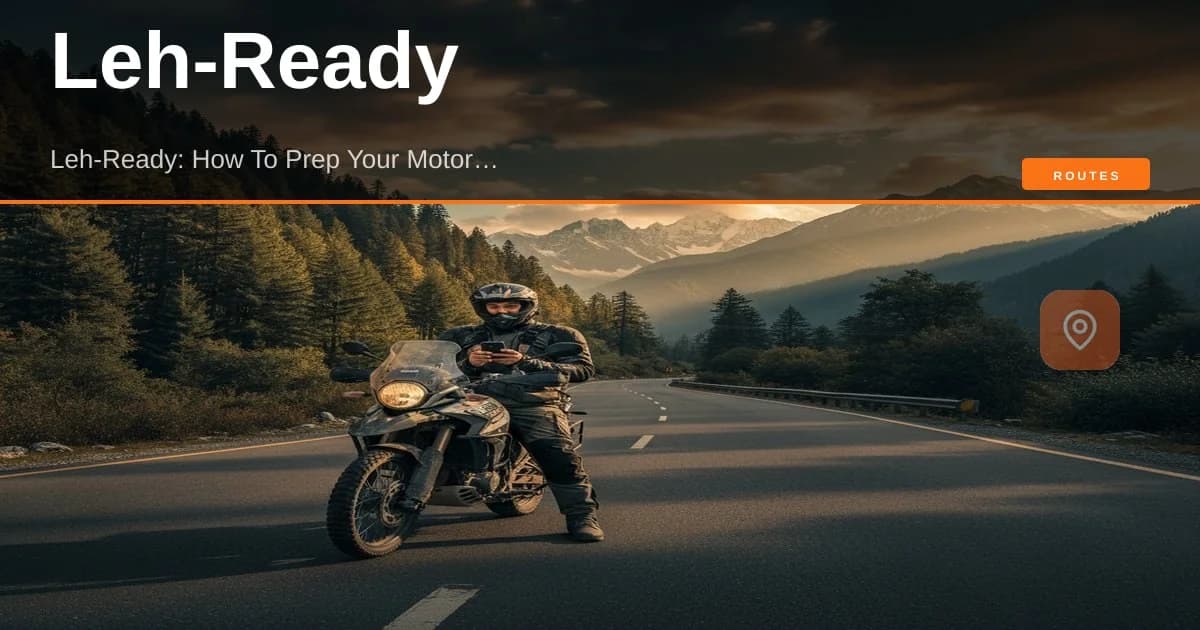
Stop scrolling through romanticized Ladakh reels and outdated forum posts. Most blogs sell you a fantasy; we're here to give you the hard data you actually need to survive and conquer the ride of a lifetime. From the brutal 345 km fuel-less death zone on the Manali-Leh highway to the local union rule that could get your rental bike impounded, this is the ground-truth guide. If you're serious about getting your motorcycle Leh-Ready: How to Prep Your Motorcycle for a Ladakh Trip in 2026, this is your new bible.
Quick Summary:
- Fuel Planning: Prepare for a 345 km fuel-less stretch between Tandi and Karu on the Manali-Leh highway.
- Permit Costs: The 2026 Environment/Development Fee (EDF) for Indian nationals is a flat ₹590 for a 7-day trip, available online.
- Acclimatization: A mandatory 48-hour rest period is enforced for all tourists arriving in Leh by air to prevent Acute Mountain Sickness (AMS).
- Critical Rental Rule: Motorcycles rented outside Ladakh (e.g., from Manali or Delhi) are BANNED from internal sightseeing in areas like Nubra Valley and Pangong Tso.
- Bike Rental Budget: The new Royal Enfield Himalayan 450 rents for approximately ₹3,000 – ₹3,500 per day in Leh for the 2026 season.
Verified by MileMarked · Last verified: March 2026
Leh-Ready: Your Ultimate Guide to Motorcycle Prep for a Ladakh Trip
Riding to Ladakh isn't just a trip; it's a pilgrimage. It's a test of your skill, your machine's endurance, and your spirit's resolve. But unlike a spiritual journey, this one requires meticulous, data-driven planning. One wrong calculation with fuel, a misunderstanding of local rules, or ignorance about acclimatization can end your trip before it truly begins.
At MileMarked, we've compiled data from thousands of kilometers ridden by our community. This isn't generic advice. This is the operational playbook for the modern Indian rider, updated for 2026.
The First Critical Choice: Manali vs. Srinagar Route
Your entire trip's success, especially your health, hinges on this first decision. While both routes are breathtaking, they have vastly different impacts on your body.
The Srinagar-Leh Highway (NH1) is the scientifically smarter choice for acclimatization. Spanning roughly 434 km, it allows your body to adjust to the altitude gradually over two days. You cross major passes like Zoji La and Namika La, but your overnight stays in places like Kargil are at a manageable altitude.
The Manali-Leh Highway, post the Atal Tunnel, is a different beast. At 430 km, it's a trial by altitude. The moment you exit the tunnel, you're thrust into high-altitude territory, climbing to over 17,000 feet at Baralacha La in a single day. This rapid ascent is a recipe for Acute Mountain Sickness (AMS).
Pro Tip: Always follow the 'Climb High, Sleep Low' doctrine. This means your overnight stay should always be at a lower altitude than the highest pass you crossed that day. It's your single best defense against AMS.
Here’s a quick breakdown to help you decide:
| Feature | Srinagar-Leh Highway (NH1) | Manali-Leh Highway |
|---|---|---|
| Distance | ~434 km | ~430 km |
| Acclimatization | Excellent (Gradual ascent over 2 days) | Poor (Rapid, high-risk ascent) |
| Road Condition | Generally better, more tarmac | More challenging, with water crossings and broken patches |
| Scenery | Lush green valleys to stark moonscapes | Dramatic, raw, high-altitude desert |
| Best For | First-timers, riders prioritizing safety and comfort | Experienced riders seeking maximum adventure |
| Our Recommendation | Go to Leh via Srinagar, return via Manali. | Go to Leh via Srinagar, return via Manali. |
Choosing the Srinagar route to begin your journey gives your body the fighting chance it needs to adapt, making the rest of your high-altitude adventure safer and far more enjoyable.
The 2026 Fuel Matrix: Planning for the 345 km Dry Stretch
Running out of fuel in the middle of nowhere at 15,000 feet isn't an adventure; it's a crisis. The most infamous section of the Manali-Leh highway is the fuel-less stretch between Tandi/Keylong and Karu, which is approximately 323-345 km. You cannot eyeball this. You must calculate it.
Here’s your fuel strategy:
- Calculate Your High-Altitude Range: Your bike's real-world mileage will drop to about 70% of its normal sea-level efficiency due to the thin air and constant gear changes. If your bike gives 30 kmpl in the city, assume it will give around 21 kmpl in Ladakh.
- Tank Up at the Last Stop: The last reliable petrol pump on the Manali side is in Tandi (or a newer one in Keylong). Fill your tank to the brim here. The next one is in Karu, just before Leh.
- Carry Spares Correctly: Always carry 5-10 litres of extra fuel.
Crucial Safety Warning: Never use standard plastic water bottles (like Bisleri bottles) to carry petrol. The change in barometric pressure can cause them to expand, leak, or burst. Invest in proper metal or thick-walled plastic jerry cans designed for fuel.
- Leverage New Fuel Stations: The good news for 2026 is that the fuel network within Ladakh has improved. Once you're in the region, you'll find operational fuel stations in Diskit (Nubra Valley), Tangtse (near Pangong Tso), and even Nyoma for those venturing into the remote Changthang region towards Hanle. These are pre-mapped on the MileMarked app for offline access.
This meticulous fuel planning transforms a potential trip-ender into a standard logistical checkpoint.
How Much Does a Ladakh Bike Trip Cost in 2026?
A common question we get at MileMarked is about the budget. While it varies with your style, a 10-day trip from Leh-to-Leh can be done comfortably within a specific range. Forget the vague estimates; here is the data for an Indian rider in 2026.
| Expense Category | Cost per Person (INR) | Notes |
|---|---|---|
| Motorcycle Rental | ₹21,000 - ₹24,500 (7 days) | Based on RE Himalayan 450 at ₹3,000-₹3,500/day. Classic 350 is cheaper at ~₹2,000/day. |
| Fuel | ₹4,000 - ₹6,000 | For a ~1200 km Leh circuit. Assumes ~₹105/litre and 20-25 kmpl mileage. |
| Accommodation | ₹8,000 - ₹15,000 (10 nights) | Based on ₹800-₹1,500/night for decent homestays/guesthouses. Camps at Pangong are pricier (~₹2,500). |
| Permits (EDF) | ₹590 | One-time fee for a 7-day trip. Includes Environment, Wildlife, and Red Cross fees. |
| Food & Water | ₹5,000 - ₹8,000 (10 days) | Based on ₹500-₹800/day. |
| Miscellaneous | ₹3,000 - ₹5,000 | Buffer for entry tickets, small repairs, etc. |
| Total Estimated Cost | ₹41,590 - ₹59,090 | Excludes flights/transport to Leh. A 10-day trip will realistically cost ₹45,000 to ₹55,000. |
Riding your own bike saves a huge chunk on rentals, but adds wear and tear and transport costs to the starting point.
Acclimatization is Non-Negotiable: The 48-Hour Mandate
Let's be crystal clear: altitude sickness can be fatal. The Leh District Administration takes this so seriously that they have mandated a 48-hour acclimatization period for all tourists arriving by air.
This means for the first two days in Leh (which sits at 11,500 ft), you are legally and medically required to do nothing. No local sightseeing, no monastery visits, and definitely no jumping on a bike to conquer Khardung La.
- Hydrate, Hydrate, Hydrate: Drink at least 3-4 litres of water daily.
- Avoid Alcohol and Smoking: They dehydrate you and hinder acclimatization.
- Rest: Your body is working overtime to produce more red blood cells. Let it.
- Consider Medication: Prophylactic use of Acetazolamide (brand name: Diamox) can help, but only under a doctor's supervision. Start the course 24 hours before you ascend.
Listen to your body. Headaches, nausea, and dizziness are early signs of AMS. Do not ignore them. Descend to a lower altitude if symptoms persist.
Permits & The Union Rule Every Rider Must Know
The permit system in Ladakh has been simplified for Indian nationals. The old Inner Line Permit (ILP) has been replaced by a single Environment/Development Fee (EDF). You can easily apply for this online at the official Leh administration portal (lahdclehpermit.in). As of 2026, the cost for a 7-day period is ₹590 (₹400 Environment Fee + ₹140 Wildlife Fee + ₹50 Red Cross).
Now, for the most critical rule that trips up countless riders:
The Leh Bike Union Rule: Motorcycles rented from outside Ladakh (e.g., Manali, Delhi, Chandigarh) are STRICTLY PROHIBITED from being used for internal sightseeing to places like Nubra Valley, Pangong Tso, Tso Moriri, or Hanle.
If you arrive in Leh on a non-Ladakh registered rental bike, you will be stopped at the checkpoints leaving Leh. You will be forced to park your bike and rent a local, Leh-registered motorcycle to proceed. This is a non-negotiable rule to protect the local economy.
- This rule does not apply to you if the motorcycle is privately owned (i.e., the RC is in your name or your parent's name).
- If you are renting a bike for the trip, the best strategy is to fly to Leh and rent a local bike there. This saves you time, fatigue, and completely avoids this major logistical nightmare.
Beyond Pangong: Exploring Umling La and the Zanskar Loop
The classic Leh circuit is incredible, but for the seasoned rider, the true adventure lies beyond.
- Umling La (19,024 ft): The new crown jewel of high-altitude riding. Certified as the world's highest motorable road, conquering Umling La is the new benchmark. The route via Hanle is desolate, challenging, and utterly unforgettable.
- Hanle: Home to India's first Dark Sky Reserve and a stunning 17th-century monastery. Stargazing here is a profound experience. You'll need to specify Hanle on your permit.
- The Zanskar Loop: This is the final frontier for off-road enthusiasts. A rugged, mostly unpaved circuit connecting Kargil to Padum and then via the new road to Darcha, it's a true test of man and machine against the raw power of the Himalayas.
These routes require more experience, better preparation, and a higher tolerance for uncertainty, but the rewards are immeasurable. You can find detailed, day-by-day itineraries for these advanced routes on the MileMarked platform, complete with verified road conditions and stay options.
Your Ladakh motorcycle trip is waiting. But it rewards the prepared, not the hopeful. Use this data, plan meticulously, and respect the mountains. The road is calling.
Ready to find your route? Explore our community-verified Ladakh itineraries on MileMarked and start building your ultimate ride.
Frequently Asked Questions
Which route is better for Ladakh by bike?
For first-time riders, the Srinagar-Leh highway is unequivocally better. Its gradual ascent over 434 km allows for crucial acclimatization to high altitude, significantly reducing the risk of Acute Mountain Sickness (AMS). The Manali-Leh route involves a very rapid altitude gain and is best suited for experienced riders, ideally on the return journey from Leh.
How much does a 10-day Ladakh bike trip cost in 2026?
A 10-day Ladakh bike trip, starting and ending in Leh, will cost between ₹45,000 and ₹55,000 per person in 2026. This estimate includes renting a Royal Enfield Himalayan 450 (~₹3,500/day), fuel, permits (₹590), mid-range accommodation, and food. The cost will be lower if you ride your own motorcycle.
Do I need a permit for Pangong Tso?
Yes, Indian nationals need an Environment/Development Fee (EDF) to visit protected areas like Pangong Tso and Nubra Valley. As of 2026, this is a single online permit that costs a flat rate of ₹590 per person for a 7-day trip. It replaces the older, more complex Inner Line Permit (ILP) system.
Is a bike rented in Manali allowed in Nubra Valley?
No. Due to a strict Leh Bike Union rule, motorcycles rented outside of Ladakh (like in Manali or Delhi) are banned from being used for internal sightseeing to places like Nubra Valley, Pangong Tso, or Tso Moriri. You must hire a local Leh-registered bike for these circuits. This rule does not apply to privately-owned motorcycles.
What is the best motorcycle for a Ladakh trip?
Adventure tourers like the Royal Enfield Himalayan 450 or the Hero XPulse 200 4V are ideal due to their long-travel suspension, comfortable ergonomics, and off-road capability. Classic cruisers like the Royal Enfield Classic 350 or Bajaj Dominar 400 are also very popular and capable choices for tackling the Himalayan terrain.