Stop listening to outdated advice. Most Spiti guides are wrong about permits, routes, and costs for Indian riders. They're either trying to sell you a package or are filled with information from a decade ago. This isn't a generic travel blog; this is the verified 2026 data you actually need to complete a Delhi to Spiti Valley by bike trip safely and on budget. We’re going to debunk the myths and give you the ground truth.
Quick Summary: Your 2026 Spiti Bike Trip Facts
- Total Cost: A 9-day self-ride from Delhi costs between ₹20,800 – ₹24,500.
- Safest Route: The Shimla-Kinnaur axis is the only recommended route for safe altitude acclimatization. Avoid the direct Manali route at all costs.
- Permits (Indian Citizens): You DO NOT need an Inner Line Permit (ILP) for the Shimla-Kaza route. Only your vehicle RC and a government ID are required.
- Critical Sections: Prepare for the treacherous, 50 km unpaved stretch from Batal to Gramphu with multiple glacial water crossings.
- Connectivity: Expect a 100 km complete network dead zone between Losar and Gramphu. Offline maps from MileMarked are non-negotiable.
Verified by MileMarked · Last verified: April 2026
Delhi to Spiti Valley by Bike: The Ultimate 2026 Planner
Riding to Spiti isn't just a trip; it's a high-altitude pilgrimage that tests your skill, your machine, and your resolve. The landscape shifts from the lush green hills of Himachal to a cold, barren desert in a matter of days. It’s a journey through some of the most treacherous and beautiful roads in the world. But planning a Delhi to Spiti Valley by bike trip requires more than just enthusiasm; it demands accurate, up-to-date information. That’s where this guide comes in.
Why the Shimla Route is Safer than Manali (A Lesson in Altitude)
The single biggest mistake a first-timer can make is choosing the wrong route. While the Manali-Kaza road looks shorter on a map, it’s a dangerous trap for the unacclimatized rider. This route forces a rapid ascent from Manali's 2,050m to the dizzying heights of Kunzum Pass at 4,551m in a single day. This is a textbook recipe for Acute Mountain Sickness (AMS), which can be debilitating or even fatal.
The correct, safer approach is via Shimla and the Kinnaur Valley. This route allows your body to adapt to the thinning air gradually over several days, significantly reducing the risk of AMS.
Here’s a look at how your body acclimatizes on the recommended Shimla route:
| Day | Location | Altitude (Meters) | Change | Acclimatization Status |
|---|---|---|---|---|
| 1 | Narkanda | 2,708 m | +2,498 m | Initial Ascent |
| 2 | Sangla | 2,696 m | -12 m | Stabilizing |
| 3 | Kalpa | 2,960 m | +264 m | Gradual Gain |
| 4 | Nako | 3,662 m | +702 m | Key Acclimatization Day |
| 5 | Kaza | 3,800 m | +138 m | High Altitude Entry |
As you can see, the altitude gain is slow and steady. This method is the foundation of every safe high-altitude expedition and is a non-negotiable part of our recommended Spiti Valley itinerary.
Rider's Tip: Avoid the temptation to push hard on the first few days. Ride at a relaxed pace, stay hydrated (drink at least 4-5 liters of water daily), and avoid alcohol. Your body will thank you for it later.
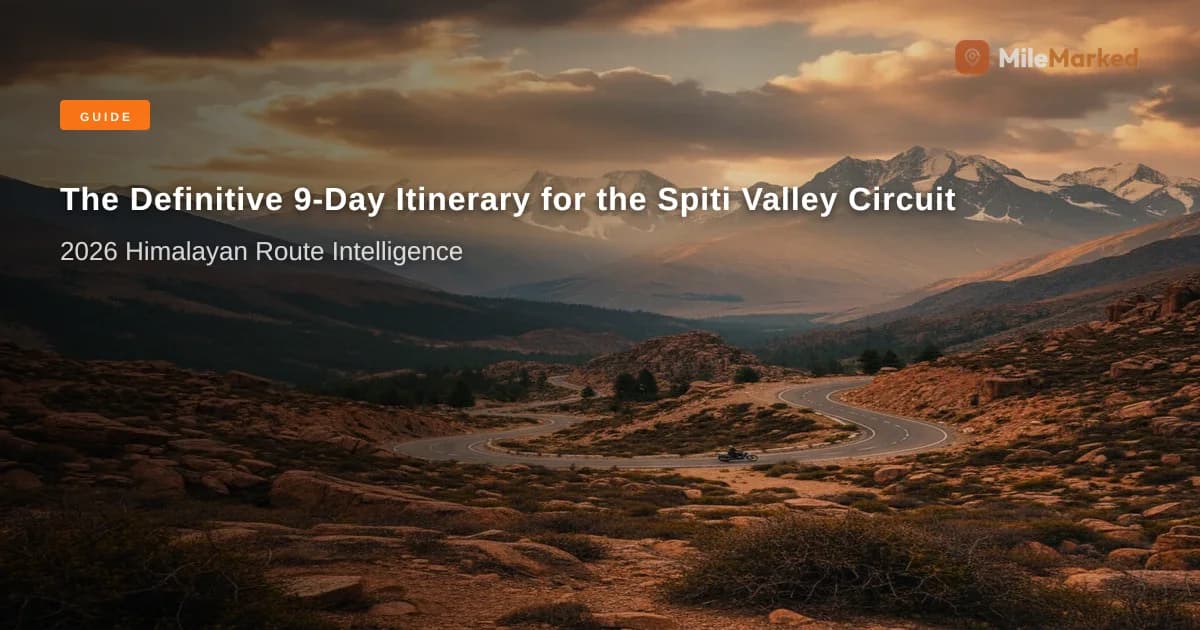
The Verified 9-Day Delhi to Spiti Valley Bike Itinerary (2026)
This itinerary is designed for intermediate riders, balancing manageable daily distances with crucial acclimatization. It covers approximately 1,800 km in a circuit, starting and ending in Delhi.
-
Day 1: Delhi to Narkanda (403 km / 10-11 hours) The journey begins. Your goal is to bypass the chaos of Shimla and push directly to the quieter town of Narkanda. The ride is a long haul on plains and then winding mountain roads.
-
Day 2: Narkanda to Sangla (160 km / 6-7 hours) You enter the beautiful Kinnaur Valley. The roads are scenic but demand constant attention. You’ll ride alongside the roaring Sutlej river for most of the day.
-
Day 3: Sangla to Kalpa (40 km / 2-3 hours) A short riding day designed for rest and local exploration. Visit Chitkul, the last inhabited village near the Indo-Tibetan border, before heading to Kalpa for stunning views of the Kinner Kailash range.
-
Day 4: Kalpa to Nako (100 km / 4-5 hours) The landscape begins to change dramatically, turning more barren and rugged. Be prepared for the infamous Malling Nallah, a notorious water crossing that can be a significant challenge, especially later in the day.
-
Day 5: Nako to Kaza (110 km / 4-5 hours) You'll pass the 800-year-old Tabo Monastery before officially entering Spiti Valley at the Sumdo checkpost. The final stretch to Kaza, the administrative headquarters of Spiti, is breathtaking.
-
Day 6: Rest and Exploration in Kaza A vital rest day. Use this time to explore the iconic Key Monastery, the high villages of Langza (famous for its Buddha statue), Hikkim (home to the world's highest post office), and Komic.
- Day 7: Kaza to Chandratal (100 km / 4-5 hours) The ascent to Kunzum Pass (4,551m) is the highlight of the day. After crossing the pass, a challenging 14 km detour takes you to the magical Chandratal Lake. Camping here is a surreal experience.
-
Day 8: Chandratal to Manali (120 km / 6-8 hours) The ultimate test of your riding skill. The 50 km stretch from Batal to Gramphu is unpaved, filled with rocks, and features several deep, bone-chilling glacial water crossings. After this ordeal, the smooth tarmac of the Atal Tunnel feels like a gift.
-
Day 9: Manali to Delhi (550 km / 12-14 hours) The final, long ride home. It’s a grueling day on the highway, but you'll be powered by the incredible memories of the cold desert.
How Much Does a Spiti Bike Trip Cost in 2026? (A Real INR Budget)
Forget the inflated prices quoted by tour operators. For a self-sufficient rider, a Delhi to Spiti bike trip is surprisingly affordable. Based on 2026 data, here’s a realistic budget breakdown for a solo rider on a bike like a Royal Enfield Himalayan.
| Expense Category | Cost per Day (INR) | Total for 9 Days (INR) | Notes |
|---|---|---|---|
| Fuel | ₹800 - ₹1,000 | ₹7,200 - ₹9,000 | Assumes ~30 km/l mileage |
| Accommodation | ₹800 - ₹1,200 | ₹7,200 - ₹10,800 | Homestays & budget guesthouses |
| Food | ₹700 - ₹900 | ₹6,300 - ₹8,100 | Dhabas & local restaurants |
| Miscellaneous | ₹100 - ₹200 | ₹900 - ₹1,800 | Permits (if any), buffer |
| Total Estimated Cost | ₹2,400 - ₹3,300 | ₹21,600 - ₹29,700 | Ride prepared! |
Pro Tip: Always carry physical cash. UPI and ATMs are extremely unreliable beyond Reckong Peo. You’ll need cash for fuel, food, and homestays throughout Kinnaur and Spiti.
Do Indian Riders Need a Permit for Spiti Valley in 2026?
Let's debunk this myth once and for all: Indian citizens DO NOT need an Inner Line Permit (ILP) or any special permit to travel the Shimla-Kaza-Manali circuit.
This is one of the most common pieces of misinformation online. You will encounter police checkposts at places like Jangi and Sumdo, but all you need to show is:
- Your Vehicle's Registration Certificate (RC)
- Your Driving License
- A valid Government-issued ID (like Aadhaar)
That's it. They will note your details in a register, and you'll be on your way. The only riders who need a Protected Area Permit (PAP) are foreign nationals.
Fuel & Network Map: The Lifelines of Your Spiti Ride
Running out of fuel or getting lost in a network dead zone can turn an adventure into a nightmare. This is where planning with a tool like MileMarked becomes critical.
Fuel Stations: The most crucial thing to know is that the fuel pump at Powari is no longer reliably operational. The last guaranteed fuel stop before Kaza is at Tapri.
- The Critical Gap: There is a massive ~360 km stretch between Reckong Peo and Kaza with no fuel pumps. You must refuel at Tapri or Reckong Peo and, if you have a smaller tank, carry extra fuel in a jerry can.
- Kaza to Manali: The next pump after Kaza is at Tandi, approximately 200 km away. Ensure you have a full tank before leaving Kaza.
Mobile Network: Prepare to be disconnected.
- The Dead Zone: There is an absolute 100 km network dead zone from Losar (after Kaza) until you emerge from the Atal Tunnel near Manali. No calls, no messages, no data.
- Best Network: BSNL/MTNL has the widest (but not fastest) connectivity for calls in the region.
- Data Connectivity: Jio and Airtel offer decent 4G in major towns like Narkanda, Reckong Peo, and Kaza, but it vanishes the moment you leave town.
📋 Spiti Valley Fuel & Network Data on MileMarked Don't get stranded. The Delhi to Spiti Valley by Bike trip page on MileMarked has the exact GPS locations of all verified fuel pumps and a detailed map of network dead zones. Download it for offline use before you ride.
Best Time to Ride to Spiti Valley
Timing your Spiti bike trip is crucial for safety and road access.
- Best Window (Late May to Mid-July): This is the sweet spot. The snow has been cleared from the high passes like Kunzum La, the weather is pleasant, and the roads are in their best condition.
- Hazardous Season (Late July to August): The monsoon season hits the lower regions of Himachal. While Spiti itself receives little rain, the approach roads through Kinnaur are highly prone to landslides, which can leave you stranded for days.
- Expert-Only (September to October): Post-monsoon, the landscape is beautiful, but temperatures drop rapidly. The risk of black ice increases, and water crossings become freezing cold. The Manali-Kaza road typically closes by mid-October.
Ready to ride the Delhi to Spiti Valley route? Don't leave home without the complete MileMarked planning kit — verified fuel stops, hotel recommendations, break points, and a packing checklist built specifically for this route. Riders who plan with MileMarked data ride smarter and worry less. Visit the Delhi to Spiti Valley by Bike trip page to download it now.
Frequently Asked Questions
Is Spiti Valley safe for bikers?
Yes, Spiti Valley is safe for intermediate to experienced bikers who are well-prepared. The primary risks are Acute Mountain Sickness (AMS) from rapid ascent, treacherous road conditions (especially the Batal-Gramphu stretch), and unpredictable weather. Following the gradual Shimla-Kinnaur route for acclimatization is the single most important safety measure.
How much does a Spiti bike trip cost from Delhi?
A 9-day solo bike trip from Delhi to Spiti Valley and back typically costs between ₹21,000 and ₹30,000 in 2026. This includes fuel (approx. ₹9,000), budget accommodation (approx. ₹10,000), food (approx. ₹8,000), and a small buffer. Costs can be reduced by staying in homestays and eating at local dhabas.
Do Indian riders need a permit for Spiti Valley?
No. As of 2026, Indian citizens do not require an Inner Line Permit (ILP) or any other special permit to travel the standard Delhi-Shimla-Kaza-Manali circuit. You only need your vehicle's RC, your driver's license, and a government ID card for the police checkposts.
Which is the best month to visit Spiti on a bike?
The best time for a bike trip to Spiti Valley is from late May to mid-July. During this period, the snow has melted from the high passes (Kunzum and Rohtang), the weather is pleasant, and the risk of monsoon-induced landslides on the approach routes is minimal.