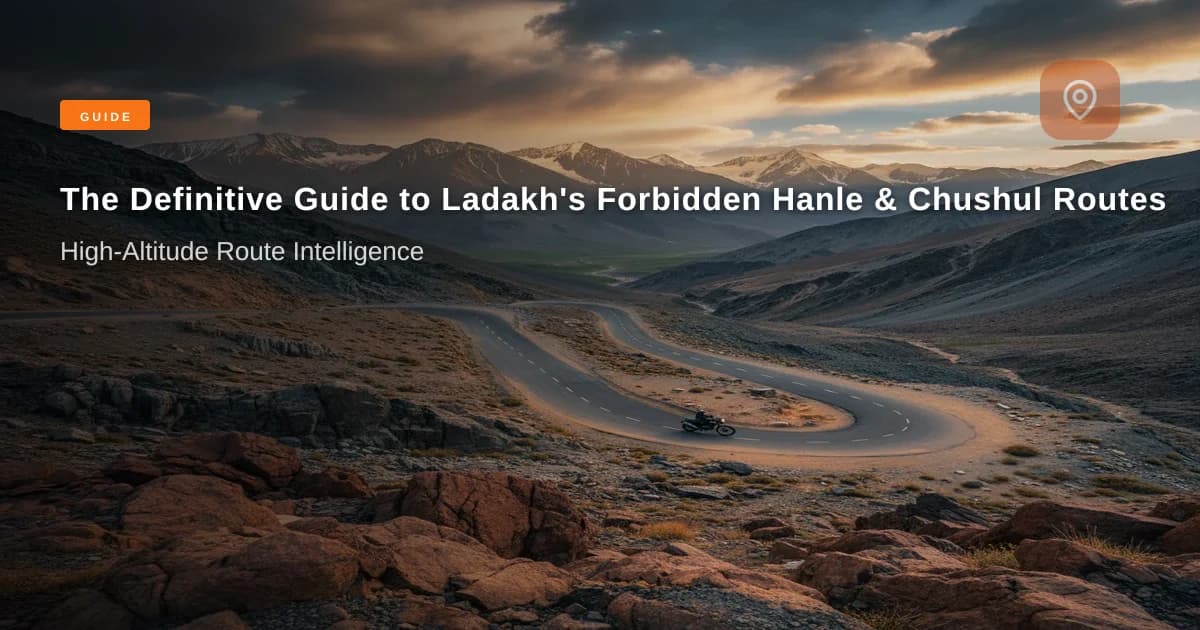
Stop scrolling through outdated forums and tour operator blogs. The rules for riding in Eastern Ladakh have changed, and the information you're reading from 2023 is now dangerously wrong. This isn't just an update; it's a complete logistical reset. The new Nyoma fuel pump has redrawn the map, digital permits have killed the day-long wait in Leh, and a non-negotiable army rule at Umling La could save your life. This is your 2026 ground-truth guide for an Eastern Ladakh by bike: a guide to the Chushul & Hanle routes, built by riders, for riders.
Verified by MileMarked · Last verified: April 2026
Quick Summary:
- New Permits: The Inner Line Permit (ILP) is replaced by an online Ladakh Environment Fee (EDF), costing ₹400 + ₹20/day per person for Indian nationals.
- Fuel Is Solved: The new Indian Oil petrol pump in Nyoma is fully operational, bridging the critical 156 km fuel-less gap from Tangtse.
- Umling La Cut-off: The Indian Army enforces a strict 2:00 PM cut-off for all civilian traffic at Umling La pass due to extreme weather risk.
- Route Difficulty: The Pangong-Chushul-Hanle route has severe off-road sections with deep sand and quicksand zones, especially between Merak and Chushul. Not recommended for beginners or heavily loaded bikes.
- Daily Budget: A realistic daily budget for a self-reliant Indian rider is ₹2,600 to ₹3,700, covering fuel, food, and basic homestay accommodation.
Eastern Ladakh by Bike: A Guide to the Chushul & Hanle Routes
For years, this circuit was the final frontier for Indian motorcycle tourers—a land of questionable "black fuel" sold in Pepsi bottles, confusing permit offices, and routes that existed only on military maps. But as of 2026, the game has changed. This guide is your new operational manual, based on verified data from the ground. We'll cover the new permit system that saves you time, the fuel strategy that eliminates range anxiety, and the real-world conditions of the legendary Chushul route.
Ladakh Permits 2026: The New EDF System Explained
First, let's clear up the biggest point of confusion: the Inner Line Permit (ILP) is history for Indian nationals. It has been replaced by the much simpler, online Ladakh Environment and Wildlife Fee (EDF).
The process is straightforward:
- Visit the official permit portal:
lahdclehpermit.in. - Fill in your details and select the regions you plan to visit (Hanle, Pangong Tso, Tso Moriri, etc.).
- Pay the fee online. The system generates a PDF receipt.
The cost structure is transparent and fixed. Here’s the breakdown for a typical 7-day trip covering the Eastern circuit:
| Fee Component | Cost (per person) | Notes |
|---|---|---|
| Environment Fee | ₹400 | One-time fee, valid for the entire trip duration. |
| Wildlife Protection Fee | ₹20 per day | Calculated based on the number of days you'll be in protected areas. |
| Total for 7 Days | ₹590 | (₹400 + [7 days x ₹20]) |
MileMarked Pro Tip: Digital is useless here. Mobile networks are non-existent at the remote checkpoints between Pangong and Hanle. The army personnel will only accept physical printouts. Carry at least 10 photocopies of your EDF receipt and a government-issued ID (Aadhaar is best). Keep them in a waterproof bag. I've seen riders turned back at the Loma checkpoint for not having a physical copy.
With permits sorted online before you even leave home, you gain a full day in Leh that used to be wasted running between government offices.
Fuel Strategy for the Changthang: Navigating the Nyoma Lifeline
The single biggest logistical revolution in Eastern Ladakh is the opening of the Indian Oil petrol pump at Nyoma. At 13,684 feet, this isn't just a fuel station; it's a lifeline that makes the entire circuit safer and more accessible.
Previously, the ride from Tangtse (the last reliable pump after Leh) to Hanle and beyond was a 300+ km gamble. Riders had two options: carry huge amounts of extra fuel, or buy impure "black fuel" from village shops at exorbitant prices (₹150-₹200/liter). This local fuel is often mixed with kerosene and can wreak havoc on a fuel-injected engine like the one on the Royal Enfield Himalayan 450.
Here’s your new, simplified fuel plan:
- Tank Up at Karu/Tangtse: Fill your tank to the brim at the well-stocked pumps in Karu or the last-chance pump in Tangtse before heading to Pangong Lake.
- The Gap: From Tangtse, it's approximately 156 km to the new pump at Nyoma via the Chushul route. Most adventure bikes with a 15-liter tank can make this, but just barely.
- Refuel at Nyoma: This is your strategic refueling point. Top up here before proceeding to Hanle (50 km away) or Tso Moriri.
The MileMarked Safety Rule: Never trust a single source of fuel in the Himalayas. The Nyoma pump can occasionally run dry or face power issues. Always carry a 5-10L dedicated jerry can with clean fuel sourced from Leh or Karu. Your bike's fuel efficiency will plummet on the sandy Chushul tracks; expect less than 25 kmpl, even on a frugal machine.
This new pump transforms the ride from a high-stakes survival challenge into a manageable adventure.
The Ultimate Eastern Ladakh by Bike Route: Pangong to Hanle via Chushul (176 km)
This is the crown jewel of Eastern Ladakh, a raw, challenging, and breathtakingly beautiful 176 km stretch that skirts the Chinese border. Do not underestimate it. While Google Maps shows a simple line, the reality on the ground is a test of skill and endurance.
Here's a segment-by-segment breakdown of the road conditions you'll face:
- Spangmik to Merak (21 km): The fun begins here. You'll ride along the shores of Pangong Tso on a mix of broken tarmac, hard-packed dirt, and patches of deep sand. It's scenic but requires constant attention.
- Merak to Chushul (60 km): This is the crux of the entire route. The track disappears into vast, open plains. You’ll navigate sandy trails, rocky sections, and notorious quicksand zones near the lake's edge. Follow the tyre tracks of army trucks, and if in doubt, walk the path first. Heavy adventure bikes like a BMW GS or Triumph Tiger will struggle immensely here. A lighter Royal Enfield Himalayan or Hero Xpulse is far more manageable.
- Chushul to Tsaga La (45 km): After the mandatory stop at the poignant Rezang La War Memorial (a non-negotiable pilgrimage), the terrain changes to corrugated, bone-jarring gravel tracks. It's a high-speed washboard that will test your suspension and every nut and bolt on your motorcycle.
- Tsaga La to Loma & Hanle (50 km): After crossing the modest Tsaga La pass, you hit the Loma checkpoint. From Loma bridge to Hanle, you are rewarded with 95 km of fresh, buttery smooth tarmac. It’s a glorious feeling after hours of punishment, but watch out for the odd sand drift across the road.
This route is a full-day commitment. Start from Pangong no later than 7 AM.
How to Safely Conquer Umling La Pass (19,024 ft)?
Riding to Umling La, the world's second-highest motorable road, is a serious undertaking. The altitude is extreme—oxygen levels are nearly 50% of what they are at sea level. The biggest mistake riders make is treating it like just another high pass.
The Indian Army, based on hard-earned experience with civilian medical emergencies, now enforces a non-negotiable 2:00 PM cut-off time. All civilian vehicles must be on their way down from the summit by 2 PM.
Why? The wind chill becomes life-threatening in the afternoon, dropping temperatures to well below -10°C even in summer. The risk of High-Altitude Cerebral Edema (HACE) and High-Altitude Pulmonary Edema (HAPE) skyrockets with prolonged exposure.
Here is the only safe timeline to visit Umling La:
- Acclimatize: Spend at least one night in Hanle (14,764 ft) before attempting the climb.
- Start Early: Leave your Hanle homestay by 6:00 AM. The 125 km ride to the summit takes about 3-4 hours.
- Summit Time: Spend a maximum of 10-15 minutes at the top. Take your photos, feel the accomplishment, and then immediately begin your descent.
- Descend: Be back in Hanle by early afternoon. Do not linger. The mountain makes the rules here, and you must respect them.
A Rider's Guide to Hanle: Stays, Costs, and the New Chumar Frontier
Hanle is more than just a base for Umling La. It's a tranquil village, home to the 17th-century Hanle Monastery and the Indian Astronomical Observatory. As India's first Dark Sky Reserve, the stargazing here is simply out of this world.
Accommodation is exclusively in homestays. They are clean, warm, and offer a wonderful glimpse into Ladakhi life.
- Cost: Expect to pay between ₹1,300 to ₹2,320 per person, per night. This price almost always includes a simple dinner and breakfast.
- Popular Options: Padma Homestay is a well-known and reliable choice, but several other families offer similar hospitality. Booking in advance is highly recommended during peak season (June-August).
For advanced riders looking for the next challenge, the Border Roads Organisation (BRO) has opened a new 91 km all-weather road connecting Hanle to Chumar via the Salsa La pass (17,200 ft). This strategic road opens up an entirely new, even more remote circuit, but permits and conditions should be verified with the army at Loma before attempting it.
Acclimatization and a Realistic Daily Budget for Indian Riders
No amount of riding skill can beat Acute Mountain Sickness (AMS). The Ladakh administration has a strict law for this: anyone flying into Leh must rest and acclimatize for a minimum of 48 hours before starting their ride. Don't be a hero; this rule saves lives.
Another critical safety tip involves water crossings. The infamous 'Pagal Nalas' (mad streams) are a real threat, especially during the monsoon months of July and August.
The 11 AM Rule: Always cross major water crossings before 11:00 AM. As the sun gets stronger, the glacial melt increases, turning a manageable stream into a raging, bike-swallowing torrent by the afternoon.
Finally, let's talk money. Forget the vague estimates you see online. Here’s a realistic daily budget for a self-reliant Indian rider in Eastern Ladakh, logged on the MileMarked platform by hundreds of riders.
| Expense Category | Average Daily Cost (per person) | Notes |
|---|---|---|
| Fuel | ₹800 - ₹1,200 | Assumes ~150-200 km/day on a 25-30 kmpl bike. |
| Food | ₹500 - ₹700 | Basic meals at dhabas and homestays. |
| Accommodation | ₹1,000 - ₹1,500 | Shared room in a homestay or guesthouse. |
| Total Daily Average | ₹2,600 - ₹3,700 | This excludes permits, bike rentals, and any major repairs. |
Riding Eastern Ladakh is no longer a leap into the unknown. With the right information and preparation, it is an achievable dream for any intermediate rider. Plan your fuel stops, respect the altitude, carry your permits, and embrace the raw, untamed beauty of the Changthang plateau.
Ready to plan your own epic journey? Explore verified, day-by-day itineraries for the Hanle-Chushul circuit and hundreds of other Indian routes on MileMarked.
Frequently Asked Questions
Do I need an ILP for Hanle in 2026?
No, the Inner Line Permit (ILP) system for Indian nationals has been replaced by the online Ladakh Environment Fee (EDF). You can apply for it on the lahdclehpermit.in portal. The cost is a flat ₹400 Environment Fee plus ₹20 per day for the Wildlife Fee.
How difficult is the Chushul route for motorcycles?
The route is very difficult and not recommended for beginners. The 60 km section between Merak and Chushul is particularly challenging, with deep sand, gravel, and potential quicksand zones with no defined road. It is best suited for lighter adventure or dual-sport bikes like a Royal Enfield Himalayan or Hero Xpulse.
What is the budget for a 7-day Eastern Ladakh bike trip?
A realistic budget for a self-reliant Indian rider is between ₹2,600 and ₹3,700 per day. For a 7-day trip, this totals approximately ₹18,200 to ₹25,900 per person, excluding bike rental, flights to Leh, and major unforeseen expenses.
When is the safest time to visit Umling La pass?
The safest and most accessible window to visit Umling La is from mid-June to late September. During this period, the snow has cleared, and the weather is relatively stable. Regardless of the month, you must adhere to the 2:00 PM army cut-off time for descent due to extreme afternoon wind chill.
Is the new Nyoma petrol pump always operational?
While the Nyoma petrol pump is a massive logistical improvement, its operation can be subject to fuel supply and weather conditions in the high Himalayas. It is generally reliable from June to September but should not be your only fuel plan. Always carry a 5-10L jerry can of spare fuel as a backup.