The photo was perfect. A gleaming motorcycle parked on a hairpin bend, with snow-capped peaks piercing a sapphire sky in the background. You've seen it a hundred times on Instagram. This is the route. You plan your leave, pack your bags, and hit the road, only to discover the reality: the "road" is a bone-jarring mess of gravel, the next petrol pump is a mythical creature 100 km away, and that stunning view is shrouded in a cloud of your own anxiety. This is the classic trap of mistaking a popular route for a reliable one. So, what makes a bike trip route reliable? The verification checklist isn't just about pretty pictures; it's about ensuring your adventure is memorable for the right reasons—freedom, discovery, and pure riding joy, not stress and survival.
A reliable route is predictable, safe, and supportive. It’s a route where you spend more time enjoying the ride and less time worrying about the next crisis. It’s the difference between a story you tell with a smile and one you tell with a shudder. This guide provides the professional 8-point framework we at MileMarked use to transform a dotted line on a map into a truly unforgettable motorcycle journey.
Quick Summary: The 8-Point Route Verification Checklist
- Biggest Fuel Gap in India: Tandi to Karu on the Manali-Leh highway is approximately 365 km with no petrol pump. Verify fuel gaps before every mountain route.
- Permit Check: ILPs are required for Ladakh (Nubra, Pangong, Hanle) and Spiti Valley. Apply online before departure — not at the checkpoint.
- Road Condition Source: Check BRO updates and the MileMarked community feed for real-time road status before riding.
- ATM Warning: ATMs in Kaza, Jaisalmer, and remote Himalayan towns run dry in peak season. Always carry ₹5,000-₹8,000 in cash.
- Mechanic Gap: The last Royal Enfield service centre before Spiti Valley is in Shimla. Plan your service stop accordingly.
Verified by MileMarked · Last verified: March 2026
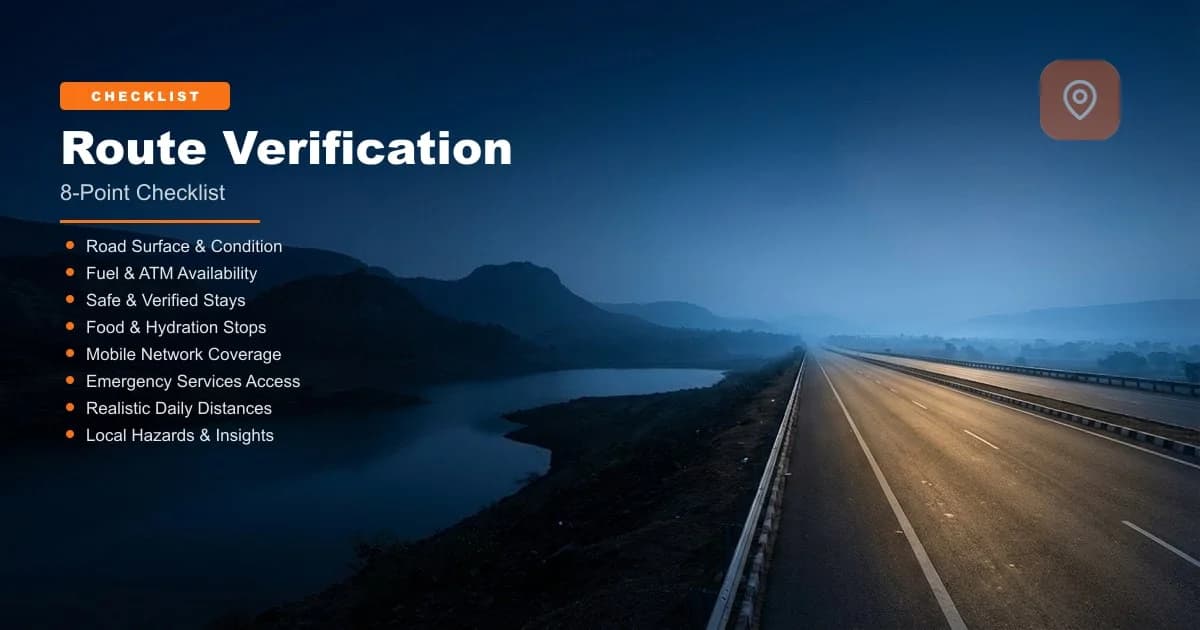
The MileMarked 8-Point Verification Checklist
Before you kickstand up, run your potential route through this comprehensive checklist. This isn't just a list of suggestions; it's a systematic process to guarantee a safer, smoother, and far more enjoyable ride.
- Road Surface & Condition: Is it smooth tarmac, broken asphalt, or a gravel trail? Knowing this dictates your speed, comfort, and even the type of bike suitable for the journey.
- Fuel & ATM Availability: What is the maximum distance between petrol pumps? Are there ATMs in the towns you plan to stop in, or is it a cash-only zone?
- Safe & Verified Stays: Are there reputable hotels, guesthouses, or campsites along the way? Have they been reviewed by other riders?
- Food & Hydration Stops: Can you easily find hygienic places for meals and water? Dehydration and hunger are enemies of focus on the road.
- Mobile Network & Connectivity: Which mobile networks work in the region? Are there long stretches with zero signal?
- Emergency Services Access: How far is the nearest hospital or clinic? Are there local mechanics who can handle a breakdown?
- Realistic Daily Distances & Timings: Does the route account for terrain, traffic, and weather? A 300 km mountain ride is vastly different from 300 km on a plain highway.
- Local Insights & Potential Hazards: Is the area prone to landslides during monsoon? Is it a known wildlife corridor requiring you to avoid riding at night?
Running your route through these eight filters is the first and most crucial step in your motorcycle route planning.
Why a 'Reliable' Route Beats a 'Popular' One
The biggest mistake a beginner rider can make is choosing a route based purely on social media hype. A single, stunning photo doesn't show the 50 km of back-breaking terrain it took to get there. It doesn't tell you the only guesthouse in the area was unsafe or that the rider nearly ran out of fuel.
A reliable bike trip route is one that has been vetted for the realities of the road. It balances breathtaking scenery with practical necessities. Think of it this way:
- A popular route might take you through a "shortcut" that turns out to be an unpaved, pothole-ridden nightmare, adding hours and exhaustion to your day.
- A reliable route sticks to well-maintained State or National Highways, even if it adds 30 km, ensuring you arrive at your destination with enough energy to actually enjoy it.
This guide will teach you how to do that vetting yourself. Let's break down the "how."
How to Check Road Conditions Like a Pro
Guessing road conditions in India is a recipe for disaster. With a road network spanning over 6.3 million kilometers, quality can change in an instant. Here's how to check road conditions before a bike trip and avoid nasty surprises.
Step 1: The Digital Recon (Google Maps)
Start with Google Maps, but go beyond just getting directions.
- Satellite View: Zoom in on your proposed route. Look for the visual texture of the road. Is it a sharp, dark, consistent line (likely good tarmac)? Or is it a faint, broken, or brown-ish line (likely a dirt track or poorly maintained road)?
- Street View: This is your best friend. Virtually "ride" sections of your route, especially in areas that look questionable on the satellite view. Look for potholes, gravel, and the width of the road. Pay attention to the date the images were captured—a lot can change in a few years.
Step 2: The Visual Proof (YouTube Vlogs)
Search YouTube for recent travel vlogs of your route (e.g., "Delhi to Spiti bike trip vlog 2024"). Watching a video from a few months ago gives you undeniable visual proof of the road's current state. Pay attention to how other bikes are handling the terrain. If you see riders on adventure bikes struggling, it might be a no-go for your street bike.
Step 3: The Rider's Grapevine (Forums & Communities)
This is where you get the most current, ground-level intelligence.
- Team-BHP: An invaluable resource for Indian road conditions. Use their search function for your specific highway (e.g., "NH44 road condition").
- ADVrider: A global forum with a dedicated India section. Great for more obscure or adventurous routes.
- Facebook Riding Groups: Join groups specific to your region or destination (e.g., "Riders of Ladakh"). Ask directly: "Planning a ride from Manali to Leh next month. How are the roads after Baralacha La?" You'll get real-time answers from people who were just there.
Pro-Tip: Understand the road hierarchy. National Highways (NH) are generally the best maintained, followed by State Highways (SH). Rural or unclassified roads are a complete gamble. For your first few trips, sticking to NH and popular SH routes is the wisest choice.
Transitioning from knowing the road to knowing your resources is the next critical step.
Mapping Fuel, Food, and Safe Stays
Running out of fuel in the middle of nowhere is a rite of passage no rider wants. In remote Indian regions like the Himalayas or the Northeast, the distance between petrol pumps can easily exceed 150 km. Proper motorcycle route planning is non-negotiable.
Finding Reliable Petrol Pumps on Highways in India
Never, ever assume a petrol pump shown on Google Maps exists or is operational.
- Calculate Your True Range: Know your bike's real-world mileage and tank capacity. If your bike can do 300 km on a full tank, plan your fuel stops as if it can only do 240 km. This 20% buffer is your lifeline.
- Identify "Dry" Stretches: Look at your route. Are there long mountain passes (ghats) or forest reserves? These are likely to be fuel deserts. Ensure you have a full tank before entering these sections.
- Trust Company-Owned Pumps: On major highways, prefer pumps operated directly by companies like IOCL, BPCL, or HPCL. They are more likely to have clean, unadulterated fuel.
- Carry Cash: In remote areas, digital payments often fail due to poor connectivity. According to TRAI, these "No Service" zones are common in tourist hotspots. Always have enough cash for at least two full tanks of fuel and a meal.
Finding Safe Stays and Hygienic Food
Your energy and health are paramount.
- Stays: Use booking sites like Booking.com or MakeMyTrip to find places with recent, positive reviews. For your first trip, avoid booking unverified "homestays" you find on a map. A comfortable bed and secure parking for your bike are worth paying a little extra for.
- Food: On highways, look for busy dhabas with lots of trucks and cars parked outside. It's a good sign the food is fresh and popular. Stick to simple, cooked meals like dal, roti, and rice. Avoid uncooked items like salads or chutneys if you have a sensitive stomach.
Beginner's Rule: For your first multi-day trip, limit your daily riding distance to under 250-300 km. This isn't a race. This gives you ample time for photo stops, food breaks, and dealing with unexpected delays without the stress of having to ride after dark.
A well-planned route for a beginner could be the Mumbai to Goa coastal road adventure, which is rich in services and scenic beauty.
What if there's no mobile network?
It's not a question of if, but when. In places like Zanskar, parts of Arunachal Pradesh, or even remote sections of the Western Ghats, your phone will lose signal. A safe bike trip in India requires planning for these blackouts.
Your phone's GPS will still work, but without data, the map won't load. The solution is simple:
- Offline Maps: Before your trip, download the entire map of your route region in Google Maps for offline use. Apps like Maps.me are also excellent alternatives.
- Inform Someone: Share your detailed itinerary, including planned night halts and route, with a friend or family member. Agree on check-in times. If they don't hear from you, they know your last known location.
- Satellite Communicators: For truly extreme and remote routes, consider investing in a device like a Garmin inReach. It allows you to send and receive text messages and share your location via satellite, regardless of mobile networks.
Unverified vs. Verified Route: A Comparison
Still not convinced? Let's put it in a table. Here’s a clear look at how a little verification work transforms your trip.
| Feature | Unverified Route (Based on a photo) | Verified Route (Using the Checklist) |
|---|---|---|
| Stress Level | High | Low |
| Road Conditions | Unknown - could be great, could be a disaster. | Predictable - you know what to expect. |
| Fuel Planning | Guesswork - "Hope there's a pump soon." | Confident - Fuel stops are pre-planned. |
| Safety | Risky - Unsafe stays, riding after dark. | High - Safe stays, realistic timings. |
| Experience | A gamble; often leads to frustration. | A true adventure; focused on the ride. |
| Cost | Unpredictable - high costs for emergency repairs. | Budget-friendly - costs are planned. |
Your First Reliable Adventure Awaits
The open road is calling, and your motorcycle is ready. The difference between a trip you endure and one you cherish lies in the preparation. This 8-point verification checklist is your key to unlocking confident, stress-free adventures.
By verifying road conditions, mapping out fuel and food, planning for connectivity issues, and setting realistic daily goals, you are taking control. You're no longer just a rider; you are the architect of your own epic journey. This is the professional approach that turns beginners into seasoned tourers.
Ready to hit the road but want to skip the exhaustive planning? We've already done the work for you. At MileMarked, every single one of our trips, from the deserts of Rajasthan to the coasts of Kerala, is built on this exact verification framework.
Explore our pre-verified routes and start your adventure with the peace of mind that every kilometre has been vetted for safety, reliability, and maximum fun:
- Jaipur to Jaisalmer Road Trip — Desert highways, minimal traffic, verified fuel & stay stops.
- Manali to Leh Bike Trip — The ultimate verified Himalayan route, complete with fuel gap warnings.
- Delhi to Spiti Valley Circuit — Full permit guide, mechanic stops, and altitude alerts built-in.
- Bangalore to Coorg Road Trip — A beginner-friendly South India route, perfect for your first test of the checklist.
Your first reliable adventure is just a click away.
Frequently Asked Questions
What should I check before a long bike ride?
Beyond checking your bike's mechanical condition (tires, brakes, oil, chain), you must verify your route. Use our 8-point checklist: check road conditions, fuel/ATM availability, safe stays, food stops, mobile network, emergency services, realistic daily distances, and local hazards like weather or wildlife.
How do you know if a road is safe for a motorcycle?
A road's safety depends on its surface, width, traffic, and visibility. Use Google Street View to visually inspect the road for potholes or gravel. Check recent YouTube vlogs for real-time conditions. Finally, consult rider forums like Team-BHP for the latest updates from fellow motorcyclists who have recently traveled that route. Avoid unpaved or poorly maintained roads for your first few long trips.
How do I plan my first motorcycle tour?
Start with a short, 2-3 day trip on a well-known route. Choose a destination that is a comfortable distance away (250-300 km per day). Use our 8-point checklist to meticulously plan your route, booking your stays in advance. Pack light but smart, including a puncture repair kit, first-aid, and rain gear. Most importantly, ride at your own pace and enjoy the journey, not just the destination.