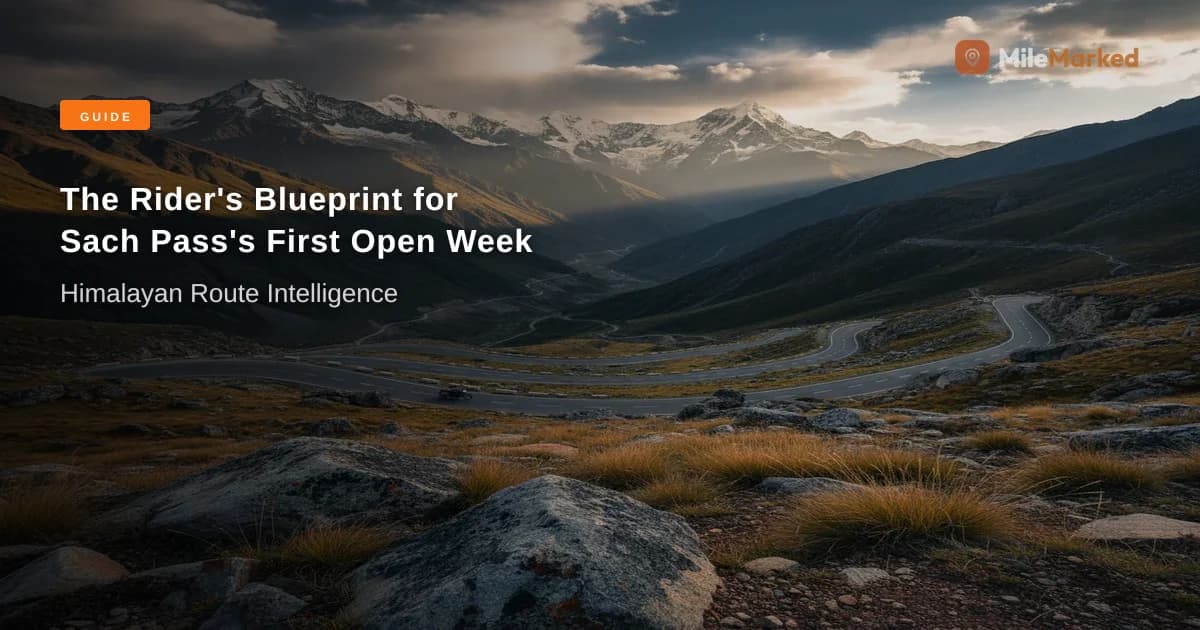
Riding Sach Pass the week it opens is a gamble against the Himalayas. Snow walls tower over you, glacial melt turns roads into rivers, and for long, heart-stopping stretches, you're utterly alone. This isn't a guide for tourists clicking pictures from a taxi. This is a tactical briefing for riders looking at the Sach Pass 2026: A Rider's Guide for the First Week It Opens, and it’s about how to win that gamble. Forget everything you've read in generic travel blogs; the first ten days after the BRO's snow cutters go home is a different beast entirely. It's a raw, unpredictable, and profoundly rewarding challenge that demands respect and meticulous planning.
Quick Summary:
- Expected Opening 2026: Late May to mid-June, depending on snowfall. Monitor official BRO and Chamba PWD announcements.
- Core Challenge: The 76 km stretch from Bairagarh to Killar takes 6-8 hours. In the opening week, expect 20-40 foot snow walls, severe water crossings post-10 AM, and black ice.
- Critical Timing: You must leave Bairagarh before 6 AM. The glacial melt intensifies dramatically as the sun gets higher, making streams impassable by afternoon.
- Permits: No special permits are needed for Indian nationals, but mandatory registration of your ID and vehicle RC at the Satrundi police check-post is required.
- Fuel Availability: There are no petrol pumps between Chamba and Tandi (a distance of over 250km). Tank up in Chamba and carry extra fuel if your bike has a small tank.
Verified by MileMarked · Last verified: May 2026
Sach Pass 2026: A Rider's Guide for the First Week It Opens
Riding Sach Pass is a rite of passage, a raw test of skill and nerve that separates tourers from true adventure riders. But tackling it in the first week it's declared open for 2026? That’s an entirely different league. This guide, built on verified data from early-season riders on MileMarked, is your tactical manual for navigating one of the Himalayas' most formidable routes when it's at its most volatile.
When Will Sach Pass Officially Open in 2026?
The million-rupee question every rider asks. Historically, Sach Pass opens anywhere from the last week of May to the third week of June. There is no fixed date. The final call depends entirely on the winter snowfall's severity and the progress of snow-clearing operations by the Border Roads Organisation (BRO) and Himachal Pradesh PWD.
These teams work tirelessly from April, cutting through metres of accumulated snow, to carve out a path. The official "opening" is announced by the District Administration of Chamba, often just a day or two in advance.
How to get the most accurate Sach Pass opening date 2026:
- Follow Official Pages: Keep an eye on the official social media handles of the Chamba District Administration and Himachal Pradesh Police.
- Local News Channels: Local news outlets in Himachal are often the first to report the opening.
- Connect with Locals on MileMarked: Check the route status updates from local riders and hoteliers in Chamba and Killar on the MileMarked platform. They have the most reliable ground-level information.
Why is the first week so unique? Because the road exists in a temporary state. It's a narrow corridor flanked by towering walls of ice, with a surface that changes not just daily, but hourly. This is not a trip you can plan with rigid certainty; it's an expedition you must be prepared for.
First Week Hazards: What to Expect After the Snow Cutters Leave
The beauty of the opening week is raw and untamed. So are the dangers. Forget the dusty, gravelly road you see in July videos. In June, you're riding through a landscape that's actively melting.
- Towering Snow Walls: Expect to ride through canyons of ice, some reaching 20 to 40 feet high. While awe-inspiring, they create a chilling micro-climate and pose a constant, low-level risk of falling ice or minor avalanches, especially on sunny afternoons.
- Extreme Water Crossings (The Real Boss Level): This is the single biggest challenge. Glacial melt creates ferocious streams that cut across the road. A trickle at 7 AM can become a bike-swallowing torrent by 11 AM. Your boots, riding pants, and engine are going to get wet. The goal is to cross them when they are at their weakest—early in the morning.
- Black Ice: The scariest hazard. In shaded corners and areas near waterfalls, meltwater freezes overnight into a transparent, treacherous sheet of black ice. It's nearly invisible. Approach any dark, wet-looking patch of road with extreme caution, especially before the sun has had a chance to hit it.
- Limited Facilities: In the first week, assume everything is closed. The famous dhaba at the summit? Probably not open. Guesthouses in Bairagarh and Killar might just be dusting off their rooms. Carry your own water and high-energy snacks. Do not depend on finding food or supplies between Chamba and Killar.
This combination of factors makes the early season ride exceptionally difficult. It's a test of momentum control, cold-weather endurance, and quick decision-making.
Verified 5-Day Itinerary: Chamba to Killar for Opening Week
This isn't a race. The key to conquering Sach Pass in June is acclimatization, preparation, and a critical buffer day. This itinerary is designed for safety and success.
| Day | Route | Distance (Approx.) | Key Objective & Notes |
|---|---|---|---|
| Day 1 | Pathankot to Chamba | 120 km | Arrive in Chamba, a proper town at 996m. Use this day to acclimatize, service your bike one last time, and get a good night's rest. |
| Day 2 | Chamba to Bairagarh | 100 km | A mix of tarmac and broken roads. Bairagarh is the last village with basic guesthouses. Get your bike ready, pack your essentials, and sleep early. |
| Day 3 | Bairagarh to Killar via Sach Pass | 76 km | The D-Day. Start before 6 AM. This short distance will take 6-8+ hours. You'll face slush, ice, and major water crossings. The goal is to reach Killar before evening. |
| Day 4 | Buffer Day in Killar | 0 km | Crucial. This day is your safety net. Use it to rest, dry your gear, or account for any delays due to landslides or impassable water crossings from the previous day. |
| Day 5 | Killar towards Keylong / Kishtwar | Varies | From Killar, you have two primary options: the infamous Killar-Kishtwar road or the route towards Keylong/Udaipur to connect to the Manali-Leh highway. |
📋 Complete Pangi Valley Planning Kit on MileMarked This route has a verified day-by-day itinerary, mapped fuel stops, hotel suggestions for every night, break points, and a downloadable packing checklist. Visit the Sach Pass & Pangi Valley trip page on MileMarked to download the complete planning kit — it's everything you need before you leave home.
Are Permits Required for Sach Pass in 2026?
There's a lot of confusion about this online. Let's clear it up with verified facts.
For Indian Nationals, no special permit is required to cross Sach Pass and enter Pangi Valley. However, there is a mandatory registration process. At the police check-post in Satrundi, you must stop and register your details.
Documents to carry for the Satrundi check-post:
- Valid Driving License
- Vehicle Registration Certificate (RC)
- A government-issued Photo ID (Aadhaar Card is best)
The officers will note down your name, vehicle number, and where you're headed. This is a crucial safety measure for tracking movement in this remote region. Do not try to skip this.
For Foreign Nationals, the rules can be more complex. While Sach Pass itself may not require a permit, venturing further into certain areas of Pangi or towards the border regions might require an Inner Line Permit (ILP). It is essential to verify the latest requirements with the local district administration in Chamba or Keylong before your trip.
Bike & Rider Prep: A Checklist for the First-Week Challenge
Your machine and your gear are your lifelines. In the opening week, there's no room for "jugaad" or "chalta hai". Preparation is everything.
Vehicle Preparation Checklist
- Tyres: Off-road capable tyres with deep treads are non-negotiable. 50/50 tyres like the Ralco Speed Blaster or Ceat Gripp XL are a minimum.
- Fluids: Fresh engine oil and a topped-up brake fluid reservoir.
- Brakes: Check your brake pads. If they are more than 50% worn, replace them. You'll be relying heavily on your brakes during the steep descent to Killar.
- Chain & Sprocket: Clean, lubricate, and ensure the chain has the correct slack. A tight chain can snap under stress.
- Nuts & Bolts: Check and tighten every critical nut and bolt. The vibrations on these roads can loosen anything.
Fuel Strategy
This is critical. The last reliable petrol pump is in Chamba. The next one is at Tandi (near Keylong), over 250 km away via Killar and Udaipur.
Pro Tip: Fill your tank to the brim in Chamba. If you're on a bike with a smaller tank (like a Classic 350), carrying 5-10 litres of extra fuel in a jerry can is mandatory.
Rider Gear Checklist
- Layers are Key: A thermal base layer, a mid-layer fleece, and a high-quality waterproof and windproof outer jacket and pants.
- Waterproof Everything: Your boots must be waterproof. Getting wet feet at 4,414 metres is a recipe for disaster. Waterproof gloves (with a thermal liner) are also essential.
- Helmet: A helmet with a clear, anti-fog visor is a must. You'll be breathing heavily, and a fogged-up visor in a tricky section is dangerous.
- Grip & Protection: Sturdy riding boots with excellent grip for wading through streams and slush.
Emergency Kit
- Puncture repair kit (for both tubed and tubeless tyres)
- Portable air compressor
- Spare spark plugs, clutch cable, and accelerator cable
- Basic toolkit, including Allen keys and spanners specific to your bike
- A comprehensive first-aid kit with medication for altitude sickness (AMS)
- High-energy food: energy bars, nuts, chocolates.
Route & Road Conditions: The Metre-by-Metre Reality
The ride to Sach Pass is a journey through changing landscapes and rapidly deteriorating roads.
- Chamba to Bairagarh: The journey starts pleasantly enough with decent tarmac, but it soon gives way to broken patches and gravel as you climb.
- Bairagarh to Satrundi: This is where the real off-road adventure begins. You're on a steep, narrow dirt track. Expect slush, mud, and the first few minor water crossings.
- Satrundi to Sach Pass Top (The Gauntlet): This is the most brutal section. The road narrows, the incline sharpens, and you'll encounter the biggest water crossings, snow walls, and potential ice patches. Your entire focus will be on maintaining momentum.
- Sach Pass to Killar: Reaching the top is only half the battle. The descent into Pangi Valley is incredibly steep and runs along a terrifying cliff edge. The road is narrow, gravelly, and prone to landslides. Keep it slow and stay in a low gear.
Pro Tip: Talk to every single taxi driver and local coming from the opposite direction. They are your real-time Google Maps. Ask them about "paani" (water crossings) and "blockage" ahead. Their information is gold.
Is This Trip Right for You? A Reality Check for Intermediate Riders
Let's be brutally honest. Riding Sach Pass in its opening week is not for beginners. It's a significant step-up from a standard Spiti Valley or Manali-Leh trip.
This journey is for the intermediate rider who has:
- Prior high-altitude experience: You should be comfortable with the effects of low oxygen and have completed at least one other major Himalayan pass.
- Proven off-road skills: You need to be confident handling your bike in deep slush, gravel, and water crossings without panicking.
- Mental Fortitude: Sach Pass will test your patience. You might be stuck for hours due to a landslide. You'll be cold, wet, and tired. The ability to stay calm and make rational decisions under pressure is more important than raw speed.
As a benchmark on the MileMarked difficulty scale, if you have comfortably and confidently completed the full Spiti Valley circuit, including the water crossings near Chota Dhara, you can consider Sach Pass as the next logical challenge. If you're still hesitant on broken roads, give this one another year.
Ready to ride Sach Pass & Pangi Valley? Don't leave home without the complete MileMarked planning kit — verified fuel stops, hotel recommendations, break points, and a packing checklist built specifically for this route. Riders who plan with MileMarked data ride smarter and worry less. Visit the Sach Pass & Pangi Valley trip page to download it now.
Frequently Asked Questions
When will Sach Pass open in 2026?
While there's no fixed date, Sach Pass is expected to open between the last week of May and mid-June 2026. The final date depends on winter snowfall and the progress of snow-clearing operations by the BRO and PWD. Monitor official announcements from the Chamba district administration for the exact date.
Is Sach Pass safe for intermediate riders?
Sach Pass, especially in the first week it opens, is a significant challenge. It is recommended for intermediate riders who have prior experience with high-altitude passes and off-road conditions, such as the Spiti Valley circuit. Beginners should avoid this route during the early season due to extreme water crossings, slush, and potential ice.
What permits are needed for Sach Pass?
For Indian citizens, no special permits are required to cross Sach Pass. However, you must stop at the police check-post in Satrundi to register your name, vehicle details, and show a valid government ID like an Aadhaar Card. This is a mandatory safety protocol.
How difficult is Sach Pass in June?
In June, particularly right after opening, Sach Pass is extremely difficult. Riders face challenges like 20-40 foot high snow walls, severe and icy water crossings from glacial melt, slush, and potential black ice in shaded areas. Facilities are minimal, and an early morning start (before 6 AM from Bairagarh) is essential to cross safely.